

Let’s be real: business development in France isn't always easy. Expanding into the French market is a journey of unique challenges and equally significant rewards for foreign SMEs.
It’s a complex landscape, but that’s precisely the mission that drives us—helping companies like yours enter and thrive in the French market.
We see the same obstacles tripping up talented teams every day. That’s why I wanted to write this: to dive into the nuances of doing business here and provide clear advice for your French expansion.
The Challenges of Business Development in France
Is Business Development in France Worth It?
Despite the inherent difficulties, engaging in business development in France is a high-yield strategic initiative for companies seeking global expansion, especially when aligned with a solid international business strategy.The French market offers significant opportunities
As of January 1, 2026, France boasts a population of 69.1 million, providing a robust and sophisticated consumer base. With a GDP of approximately €2.8 trillion, it remains the world’s seventh-largest economy and a primary engine of the European Union.
The French business landscape is currently more vibrant than ever. In 2025, the country saw a record-breaking 1.2 million new businesses created—a testament to its dynamic entrepreneurial spirit. For foreign firms, France is not just a destination but a launchpad: it has been ranked #1 in Europe for foreign direct investment (FDI) for five consecutive years, securing 1,878 new investment decisions in 2025 alone.
Do we notice this at Masson International, too? Oh yes, and we are in the front row! In the past five years alone, we had clients from Germany and the UK going from 0 sales in France to 6-figure annual sales in a matter of 2 years. It required efforts on their side (and ours!), but they clearly saw a drastic improvement in their annual sales results.
The French market offers significant opportunities, particularly for innovative products and services, acting as a gateway to broader European markets. If you are planning a wider expansion, understanding how to sell in Europe vs the US can significantly impact your results.

Why Is Business Development in France So Hard? Understanding the French Business Ecosystem
The French business ecosystem, while robust, can be particularly challenging for foreign firms due to its unique particularities. Many of these challenges are similar to those described in our recent article: Common mistakes in international business strategies in Europe.
Across all the conversations with Masson International's clients or prospects, the same topics always come up:
- Language as a Gatekeeper
- Hierarchical Decision-Making
- “Relationship First” Model
- Summer Vacations, Demonstrations, Holidays
- Bureaucracy or Market Regulations
- Rigid Labor Laws and High Social Charges
As experts in market entry and business development in France, we think these are four you must keep in mind because they are the ones most slowing down the companies we talk to:
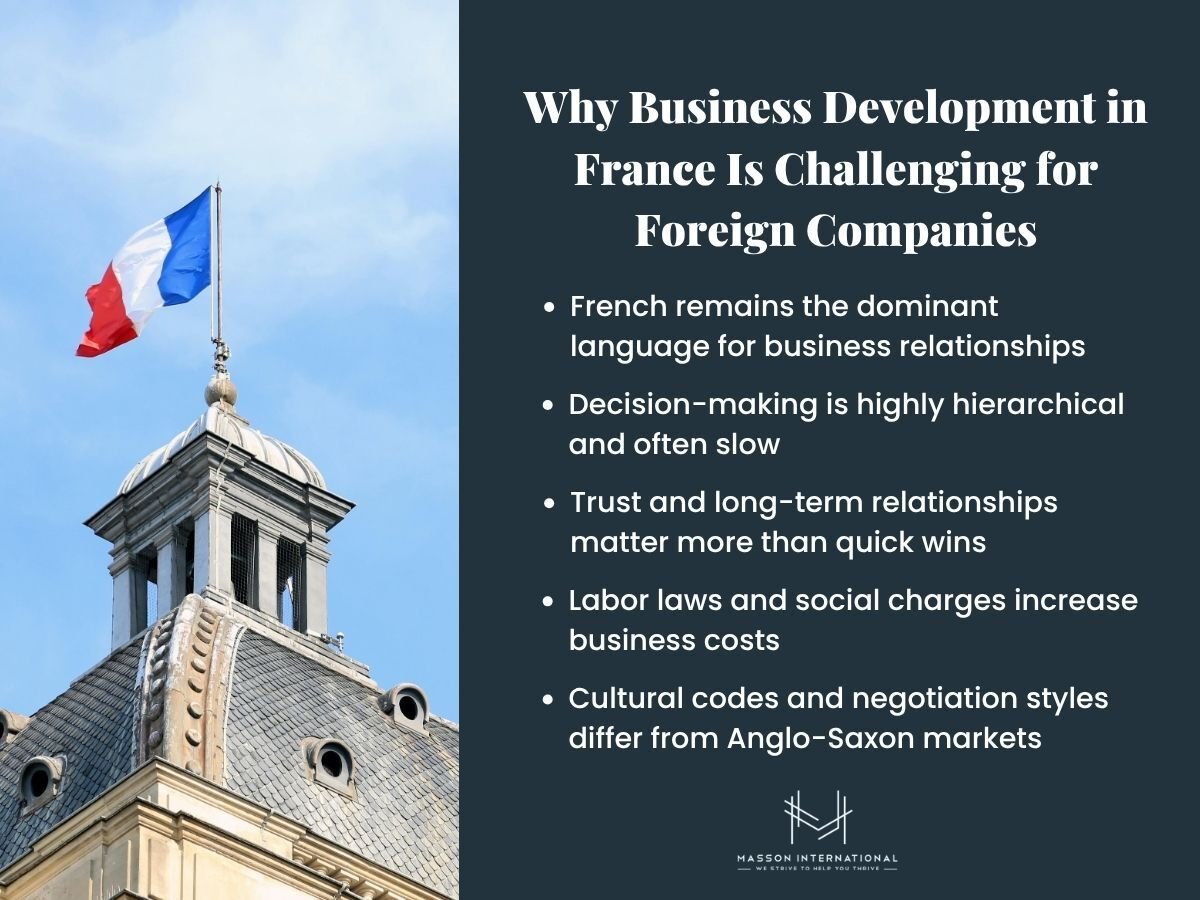
Language as a Gatekeeper: While some French professionals speak good English, the majority of French decision-makers would speak decent English to place an order or convey a message, but not more. French remains the language of business.
Hierarchical Decision-Making: French corporate culture is traditionally top-down. Decision-making power is usually concentrated at the very top (the C-suite or Directeur Général). Finding and reaching the actual decision-maker can take months, as middle management often acts as a gatekeeper without the authority to sign off on deals.
The “Relationship First” Model: In France, people do business with people they trust, not just the best product. Success depends on long-term networking, face-to-face meetings, and lunches that can last long. Trust is earned slowly and is rarely granted to “outsiders” immediately.
Rigid Labor Laws & High Social Charges: Terminating a contract is a lengthy, expensive, and legally risky process, which makes companies very hesitant to take a chance on new partners or hires. The cost of doing business is elevated by high employer contributions. Social security and payroll taxes in France are among the highest in the OECD, frequently adding another 40–45% on top of a base salary. This significantly inflates the budget required for business development teams.
Cultural Barriers to Entry in the French Market
Cultural barriers represent a significant hurdle for effective business development in France. These are often underestimated by foreign companies:
- Nuances of French communication,
- Emphasis on formality,
- Specific etiquette in business negotiation
It can sometimes profoundly impact partnership formation and client relationships.
Developing strong communication strategies and leveraging local expertise are crucial to overcome these challenges, ensuring that your business can genuinely engage with the French market.
Key Sectors for Business Development in France
Major Industries in France
France boasts a diverse and dynamic economic landscape with several major industries offering fertile ground for business development.
Historically strong sectors include:
-
Aerospace: France’s top trade contributor with €35.1 billion in 2025 exports and a 15.5% global market share. Airbus and Safran drive an order book that currently spans over a decade of guaranteed production.
-
Luxury Goods: Led by LVMH (€80.8B revenue in 2025), this sector dominates global high-end fashion and cosmetics. Exports reached €25 billion last year, with 6% organic growth projected through 2026.
-
Agriculture & Agrifood: France is the EU’s top producer, generating 25% of the Union’s total agricultural output. Wine and spirits remain the crown jewel, contributing €15.6 billion in export revenue in 2025.
-
Pharma & Chemicals: A research powerhouse with $38.7 billion in annual exports and Sanofi reporting €43.6 billion in 2025 sales. The government is currently funding the repatriation of essential medicine production via the "France 2030" plan.
-
Transport & Mobility: Includes automotive giants and rail leader Alstom, which holds a record €100.3 billion order backlog. Electric vehicles now account for 20% of new French car registrations as of early 2026.
-
Energy & Nuclear: France exported a record 92.3 TWh of low-carbon electricity in 2025, maintaining a 95% carbon-free power mix. The sector is scaling further via €54 billion in state investments for new nuclear reactors and solar hubs.
Understanding these key sectors is paramount for any foreign business looking to strategically expand and find its niche within the French market. This approach is closely aligned with building a strong international sales strategy in Europe.
Key Opportunities in Growing Sectors
These areas present excellent avenues for companies to expand, leveraging France's commitment to technological innovation.
These sectors are often backed by governmental organizations, such as Bpifrance:
- AI & DeepTech
- Cybersecurity
- Fintech
- HealthTech
Success Stories from Foreign SMEs in the French Market
Case Study: A Successful Entry in France From a Client
Allow me to share with you a story from one of Masson International's clients.
The European office of a Japanese company was having a hard time connecting with French distributors for their products. They formerly worked with a consulting firm to identify French companies, but the foreign consulting firm couldn't succeed in engaging with local distributors. They had 0 responses, or very elusive ones, from potential French partners.
How did Masson International solve their problem?
- We identified more targets: the original list was good; some major companies were listed. However, when your company wants to have multiple distributors, good isn't enough. You need an exhaustive list to maximize your sales potential, and searching companies locally, from a native language perspective, made a huge difference.
- We approached distributors in their native language and locally: As mentioned earlier, English isn't spoken very well by French businessmen (or at least they don't want to). This is why our local approach, spearheaded by our French business developers, triggered not a few, but 12 strategic business meetings!
- We bridged the gap in the onboarding phase: once the 12 business meetings had passed, 7 distributors were interested in continuing discussions. To successfully convert them into partners, we continued to work alongside our clients until the first orders, product trials, and agreements were signed.
By embracing a strategy of localization and direct engagement with the French market, supported by our deep knowledge of the sector, it transformed their approach. This strategic pivot allowed them to secure key partnerships and now make strong sales in France.
Want to learn more about this case study and others? Feel free to check out our Case Studies page.
Lessons Learned from Client Experiences
Let me share with you what our clients learned, sometimes the hard way, so you do improve your approach:
- Prepare your French tradeshows: one company told me yesterday they invested €20,000+ in a booth at a show in Paris, expecting customers to show up. Only a few strong leads visited, and none of them now seem to progress. The outcome would be different with a prospecting action before and after the show. Need a help with this? We can support.
- No Shows and No Responses: Especially after COVID-19, we noticed that business people became less responsive and cared less about responding. No-show rates have increased, even with prospects who said they were genuinely interested in the first place.
- Build relationship ASAP: French decision-makers buy from people they trust and like. Our success rate in connecting companies to clients or distributors is through the roof (>90%), but only 70% really close the deal opened or make it progress in the pipeline. What's often the gap? Our clients are delaying the moment where they engage with the contact and take time to go visit them in person or meet them again virtually. Follow-up and building a relationship are absolute musts! This 20-25% gap reduces a lot when they have one account manager engaged in nurturing the warm prospects (and if he/she speaks French); or when our client entrusts us with this part.
- Full remote, no French speakers in the long term: Even if your product makes wonders and you succeed in getting sales in France, don't be naive. If you really want to sell, visit regularly, and when you reach a plateau (you don't need to at first), hire a French-speaking sales representative. Remember what I said earlier, the 20-25% gap we have between our clients that succeed and those who do not?
- Problems with the French-speaking representative: Two errors our clients and prospects made before engaging with us: (1) thinking that because a person speaks French, it makes them a good sales representative, and (2) hiring the person and letting them be on their own without proper management and a goal-oriented strategy.
Our case studies consistently reveal that a critical lesson in business development in France is the need for patience and adaptability. Many clients initially underestimate the time required for negotiation and relationship building within the French business environment.
Effective Strategies That Worked for Our Clients in Their Business Development in France
The successful approach we recommend (and are here to execute for you) is developing a comprehensive market entry strategy that focuses on building proximity to customers through localized direct engagement. This is a key pillar of any successful international business strategy.
This allows our clients to not only navigate but also conquer the competitive landscape, expanding their operation and creating new revenues generated in France.
Create a Proximity to Customers & Partners
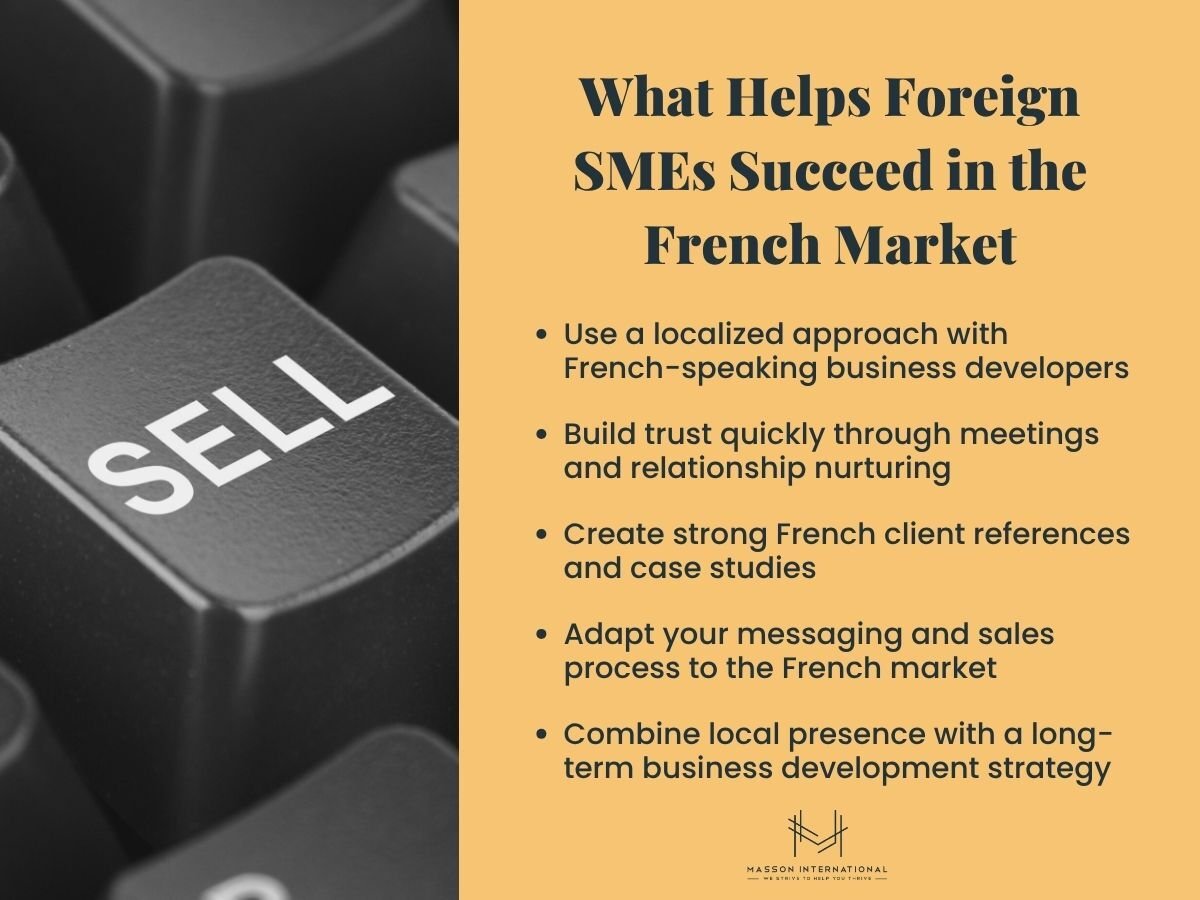
To effectively engage in business development in France, creating strong proximity to customers and partners is indispensable.
This means not just having a friendly e-mail to connect, but it goes much deeper:
- Localized approach to customers: i.e., native language, local person, local cellphone number, emails, and docs in French, etc.
- Visiting them as soon as possible
- Create openness and trust on both sides
- Eventually physical presence with an office.
Sounds like a large investment of time and money for you? Let us do this for you; this is our core mission.
Building these relationships helps foster trust and facilitates faster and larger sales in the French market. If your go-to-market relies on partners, this also aligns with best practices on
how to work with an international distributor.
Building French Client References
When we start working for a new client on their business development, one of our first steps at Masson International is to develop a story appealing to French customers or distributors.
No one knows you in the market, or maybe you have a few client references already. This is our starting point.
- You have French references? Go build on them, overuse them, create case studies!
You're a foreign company that French firms know little about; if other Frenchmen can relate to your existing French clients, you've done 25% of the job without moving a finger. - You do not have French clients? Fine. This is where our company will focus first (or yours if you're doing it by yourself). Let's build your first 5 references, even at a discounted rate if need be. A few French brand logos in your next sales presentation will tremendously ease the conversations.
Hiring a Business Development Manager in France
Almost all of our clients that go direct to customers (without distributors) reach three plateaus in their France sales growth:
- The first plateau is reached when reduced sales they succeeded in having are stagnating. This is without us helping, meaning pure remote sales and no French speaker in the company.
- The second plateau is when they work with us to build a strong sales pipeline, but they have no French-speaking closer yet. We can make great amounts of sales together, but at some point, having a French sales representative will be a plus.
- The third plateau is when the French sales representative is hired but isn't tied to a formal French entity with an office in France. He succeeded in building trust and strong sales, but it isn't the same as having a sales office to invoice your customers from France.
In the long run, hiring a skilled business development manager with at least 5 years of experience in business development jobs in France and deep knowledge of the French market is a strategic imperative.
Such an individual can be instrumental in identifying key opportunities, executing robust strategies, closing deals, and building essential relationships. Their expertise in local business etiquette and negotiation can significantly accelerate your company's growth and help you establish a strong foothold in France.
Tailoring Your Business Development Strategy
Tailoring your business development strategy is crucial for success in France. This involves a thorough analysis of the sector you aim to penetrate, understanding local client behavior, and adapting your offerings accordingly.
Here are the key aspects we keep an eye on to maximize our clients' success:
- Is the messaging tailored for the French culture and market?
- Are the USPs appealing to a French client?
- Is the product needed by clients?
- Is the client profile correct for the French market, or is it different here?
- Is the decision-maker or decision-making process different in France?
A flexible approach allows for quick adjustments based on market feedback and competitive landscape, ensuring that your initiatives are relevant and impactful, leading to greater adoption and a stronger market presence.
In addition, leveraging digital ads and resources can provide numerous benefits, especially in today's interconnected world. Utilizing targeted digital marketing campaigns, a French website or French brochures can significantly boost your reach and engagement within the French market.
Looking for a Business Development Agency in France?
Navigating the complexities of business development in France often requires specialized expertise. If your foreign SME or mid-size company is looking to effectively penetrate and expand within the French market, partnering with a dedicated business development agency can provide invaluable support.
Such an agency offers deep knowledge of the local ecosystem, helps in tailoring robust market entry strategies, and ensures that your initiatives are executed with precision, driving significant growth and sustainable success.
If this is what you are looking for, feel free to contact us at Masson International.